No IT team needed
Runs with little IT
Cloud software we operate for you—no servers, no administration, just a browser. Also a great fit for small and mid-sized manufacturers.

productionOS is not an MES and not a MOM, but an Integrated Production Management System (IPMS) – a class of its own. It resolves entire orders, plans child orders and spans one continuous order bracket across every part of an article – so every measurement and process is linked to the individual part. The data foundation for end-to-end traceability, the digital product passport and AI – with or without an ERP, without much IT involvement.
With little IT, no big project—and exactly the data foundation that makes traceability and AI in production possible in the first place.
Cloud software we operate for you—no servers, no administration, just a browser. Also a great fit for small and mid-sized manufacturers.
Planning, confirmations, inventory, quality and costs in one system—instead of scattered, outdated spreadsheets. One truth for everyone.
No months-long rollout. Up and running in days, first results immediately—grow instead of waterfall.
A clean interface and a touch terminal for the shopfloor. People are productive in minutes, not after weeks of training.
Start with one module and expand over time—without losing the bigger picture. Use only what you need.
No ERP? productionOS runs on its own. Got an ERP? It connects via API and complements it—no double data entry.
Which machine, which lot, which measurement belongs to which part? That mapping is the basis of all traceability—and only possible with an end-to-end system.
AI needs clean, connected data. productionOS creates exactly this structured data foundation—the prerequisite for meaningful AI in manufacturing.
Operated in Europe, remote-first. Your production data stays under European data protection.
productionOS is not a classic MES or MOM, but an end-to-end Integrated Production Management System (IPMS). Its difference: an order bracket that connects all orders, parts and process data of an article into one traceable whole.
Each part brings its own process & measurement data (colors) – the order bracket rolls them up to the finished article.
productionOS replaces fragmented production control with an integrated backbone—creating direct operational impact.
Information is inconsistent, manually transferred, and often available too late.
Planning, execution, materials, quality, and costs operate on the same data foundation.
Data is incomplete, inconsistently linked, and only partially audit-ready.
Batches, serial numbers, process steps, and quality data are documented automatically.
Decisions are made without directly knowing the economic impact.
Materials, labor, scrap, and rework become continuously visible and controllable.
productionOS connects core manufacturing processes in one system: less coordination overhead, faster decisions, better performance.
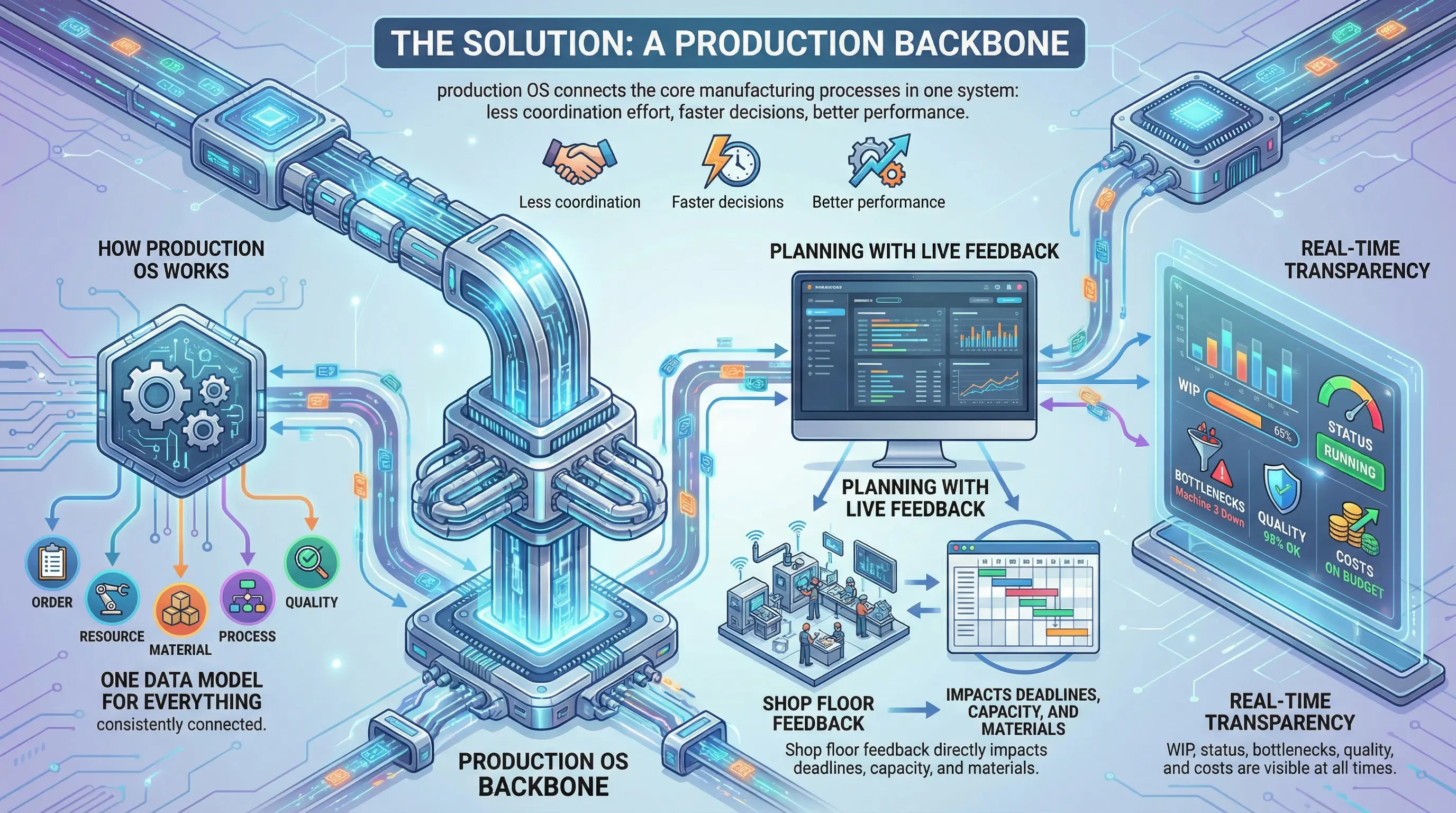
productionOS connects planning, execution, materials, quality, traceability, and real-time costs into a single production backbone.
The IPMS triad – Manufacturing Flow Design, Planning and Execution – plus materials, traceability, quality and costs. Adopt modularly without losing end-to-end integration.
Articels, materials, machines, operations, recipes, times, calendars, etc., and their relationships.
Tech viewBase model + relationships (article/material/machine)
Capacity, dates, priorities—with feedback from execution.
Tech viewConstraint model + feedback loop (capacity/material/status).
Status, reporting, disruptions, shift models, digital operations.
Tech viewState machine per order/operation + events from line/station + separate worker UI.
Consumption, reservations, inventory, postings—traceable and current.
Tech viewInventory/reservations + WIP ledger with posting logic.
Batch/serial logic, audit trails, evidence—by design.
Tech viewLot/serial graph + evidence export (audit pack).
Inspections, deviations, rework/scrap, causes, actions—on the line.
Tech viewQC events + CAPA workflows at process step level.
Actual cost per order/item, scrap cost, rework—visible immediately.
Tech viewNear-real-time aggregation from material/time/scrap/rework.
Many manufacturers run on ERP + point tools + spreadsheets—creating handoffs, inconsistent truth, and slow reactions to deviations.
ERP, shop floor systems, Excel, and siloed solutions operate side by side without a common data model. Information must be transferred manually, is inconsistent, and becomes available with delays. Decisions are often based on outdated or contradictory data.
Traceability is often established via Excel, add-on tools, or manual documentation. Data is incomplete, not consistently linked, and only partially auditable. Tracking individual items or specific processes is hardly possible or very time-consuming.
Materials, time, scrap, and rework are only posted to the ERP system after the fact. Cost analyses are typically performed after orders are completed or on a monthly basis. Operational decisions are made without direct insight into their economic impact.
Typical scenarios we improve measurably in discovery + pilot.
How execution events automatically update delivery risk, costs, and traceability.
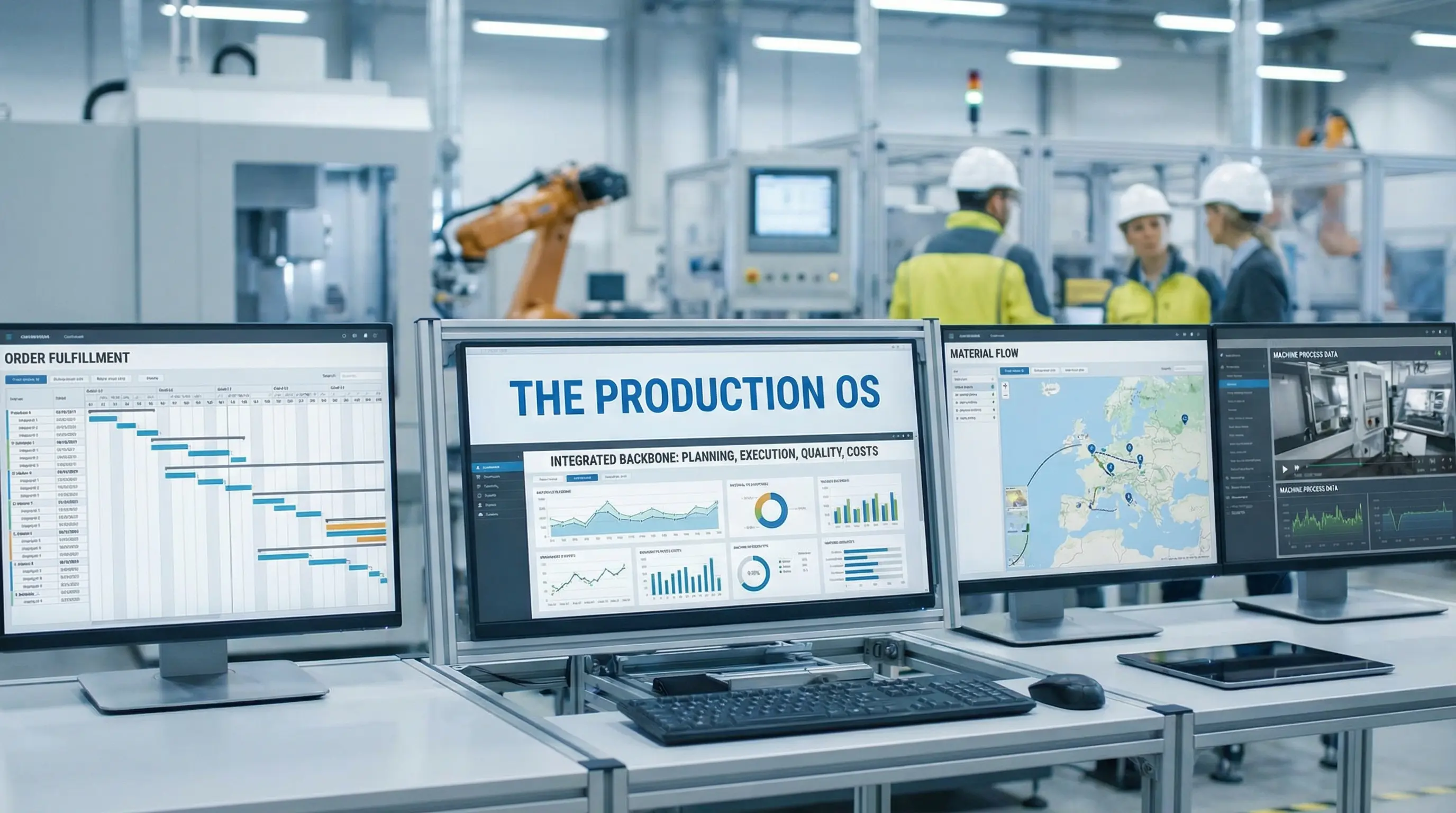
Use cases built on the end-to-end data model.
productionOS complements your ERP and connects machines/shopfloor data—consistent flow without double maintenance.
Master data, orders, BOMs, confirmations—defined interfaces.
Tech viewSync modes: batch, near-real-time, webhooks/APIs.
Status, disruptions, counters—for OEE, root-cause analysis, and monitoring.
Tech viewEdge gateway/adapters for robust environments, optional offline tolerance.
Export/connect to BI tools for management reporting (KPIs, trends, benchmarks).
Tech viewExports + KPI model with auditable snapshots.
Cloud-native with roles/permissions and audit trails. Optional: edge setup for robust environments.
Granular access for shopfloor, quality, planning, management—including audit logs.
Tech viewRBAC + audit logs, tenant isolation, least privilege.
SaaS operation with an optional edge component for robust shopfloor environments.
Tech viewBackups, retention, rollout strategy, monitoring.
What sets productionOS apart under the hood—API-first, multi-tenant and cloud-native.
A complete, versioned REST API (FastAPI, OpenAPI/Swagger). Machine, line-controller and measurement data flow in via REST/webhook—batch or near real-time.
One instance, cleanly separated across multiple plants and customers—ideal for rolling out across many sites.
JWT with scope claims, granular RBAC, refresh-token rotation, a complete audit log and retention—aligned with TISAX requirements.
Forward and backward lot/serial tracing and evidence export—systemically anchored in the production flow (DPP-ready).
Actual costs, scrap and rework per order—aggregated from production events, not in a monthly report.
PostgreSQL, containerized on Kubernetes (k3s) with auto-scaling, plus an optional edge component for robust, offline-tolerant shopfloor environments.
A dedicated touch-optimized terminal (login by employee number/PIN) for confirmations, measurement capture and material additions right at the line.
MES, MOM, ERP and AI in production – briefly explained.
productionOS is an Integrated Production Management System (IPMS) for manufacturers – a class of its own beyond classic MES/MOM. It unifies production planning, shopfloor execution, materials, quality, traceability and real-time costs in one end-to-end integrated system – usable with or without an ERP, with little IT.
An ERP handles commercial planning – orders, purchasing, finance. An MES (Manufacturing Execution System) controls and captures production in real time on the shopfloor: operations, machines, materials, quality and traceability. productionOS is the MES and complements an ERP – or runs on its own when there is none.
MES (Manufacturing Execution System) refers to the execution layer of production. MOM (Manufacturing Operations Management) is broader and also covers planning, quality, maintenance and inventory. productionOS covers both – from detailed scheduling through execution to quality and real-time costs.
Yes. productionOS is built as cloud SaaS: no server, no administration, just a browser. It can be adopted step by step – without a big IT project – making it also a great fit for small and mid-sized manufacturers with little IT.
Yes. Without an ERP, productionOS runs on its own as the leading system for manufacturing. With an ERP it connects via REST API and webhooks, takes over master data and orders and returns confirmations and costs – without double data entry.
Instead of scattered spreadsheets for planning, confirmations, inventory, quality and costs, productionOS brings everything into one data model – one truth for everyone. Every measurement and process is linked to the right part: the basis for end-to-end traceability and AI.
The digital product passport bundles a product's origin, material and process data across the supply chain – an EU requirement, including the battery passport. productionOS anchors lot and serial-number traceability and evidence exports directly in the production flow and is therefore DPP-ready.
AI needs clean, connected production data. By consistently linking processes, measurements and parts, productionOS creates exactly this structured data foundation – the prerequisite for meaningful AI in manufacturing.
productionOS resolves entire orders, plans child/secondary orders and checks material stock – spanning one continuous order bracket across every part of an article. Classic MES/MOM process seemingly independent production orders; productionOS keeps the relationship intact and links all process data to the individual part – the basis for end-to-end traceability, the digital product passport and AI.
An IPMS is a platform integrated from the ground up for the entire production management – as opposed to a collection of separate ERP, MES, PLM and quality systems. It combines Manufacturing Flow Design (process and resource design), Planning (synchronizing advanced scheduling/APS) and Execution (real-time control and complete data capture) on a unified data model – with end-to-end traceability and a digital product passport.
In the classic sense, neither: productionOS is an IPMS (Integrated Production Management System) – a class of its own. It covers the tasks of MES and MOM but goes beyond them by resolving entire orders, forming one continuous order bracket and linking all process data to the individual part. In short: yes, it also handles classic MES/MOM tasks – as part of an integrated whole.
A pragmatic path from discovery to pilot to scalable rollout.
Map constraints, data sources, KPIs and select the first measurable use case.
Integrate ERP + one line, validate feedback loop, prove value with OTD/WIP/cost.
Scale to plants, harden security/ops, standardize adapters and governance.
We’ll show on your typical cases how productionOS connects planning, shopfloor, materials, traceability, quality, and costs—and where the fastest levers are.
Email:
hello@production-os.eu
Location:
Europe · Remote-first
Send a short context (production type, ERP, biggest constraints) and we’ll reply with a concrete proposal for discovery & pilot.